
Strong offers still fall flat when the message feels fuzzy, generic, or hard to act on. When readers can’t quickly grasp what’s different, what they’ll get, and why it matters now, they hesitate—then bounce. That’s why a repeatable system beats “winging it” every time you write a landing page, product page, or email sequence.
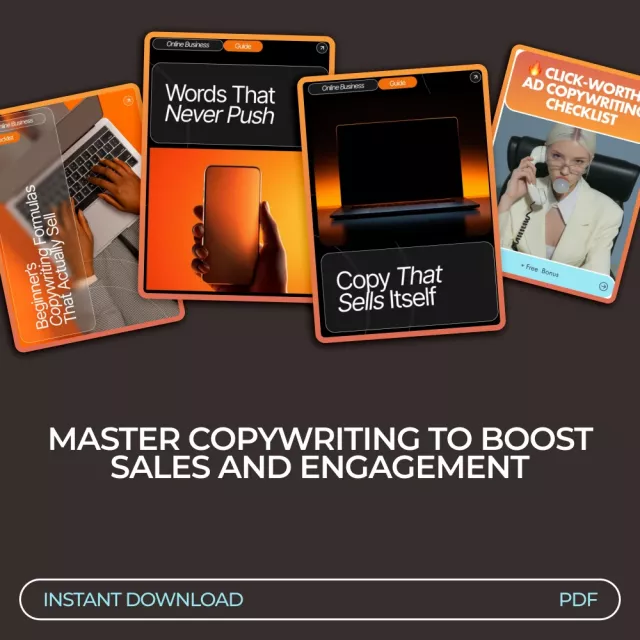
Master Copywriting for Your Offer bundle is a 4-in-1 digital package designed to turn scattered ideas into sharper positioning, persuasive page structure, and publish-ready copy using guides, eBooks, and practical checklists you can reuse across offers and campaigns.
Because most conversion issues aren’t “writing talent” problems—they’re decision-clarity problems. Scannable structure, specific claims, and relevant proof help readers understand the offer fast. (For a useful reference on scanning behavior, see Nielsen Norman Group’s research on how users read on the web.)
If multiple stakeholders touch your copy (founder, designer, media buyer, VA), checklists become the shared language for “what good looks like,” making approvals faster and revisions less subjective.
A clean workflow prevents the most common trap: writing paragraphs before the promise is precise. This is a simple sequence that works for new launches and for fixing underperforming pages.
This aligns well with the idea of making content genuinely helpful and people-first—useful framing from Google’s guidance on creating helpful content.
Persuasion works best when it reduces uncertainty—not when it adds pressure. For a broader look at how digital experiences can shape decisions, see the Stanford Persuasive Technology Lab.
Use this as a final pass before a launch, relaunch, or a major page revision. Pair each copy asset with a checklist so the writing stays consistent across channels.
| Asset | Write this | Check for | Most common fix |
|---|---|---|---|
| Headline + subheadline | Outcome + audience + differentiator | Clarity in 3 seconds, no vague claims | Replace abstractions with a measurable or time-bound result |
| Lead section | Problem framing + stakes + promise | Reader feels understood, smooth transition to solution | Add a concrete “this is for you if…” line |
| Benefits block | Before/after and use-cases | Benefits > features, easy scanning | Turn features into outcomes using “so you can…” |
| Proof section | Testimonials, examples, data, demos | Proof matches the main promise | Swap generic praise for result-focused proof |
| Offer stack | What’s included, access, timelines | No ambiguity about deliverables | Add bullets for deliverables and format |
| CTA + risk reversal | Single action + guarantee/next steps | Low anxiety, clear next step | Add what happens immediately after purchase |
If you’re also creating product demos, UGC, or quick talking-head ads, pairing clearer messaging with stable recording setups helps your content look more credible. A simple support tool like the Adjustable tabletop phone stand for livestreaming & vlogging can make it easier to record consistent proof clips, walkthroughs, and FAQ videos.
For ecommerce operators managing multiple products, the same checklist logic can keep pages consistent—even across different categories. For example, a small digital download like Your Everyday Scent Made Simple – Daily Perfume Checklist still benefits from the same core blocks: clear promise, concrete inclusions, relevant proof, and a low-friction CTA.
It works for both: beginners get step-by-step structure and checklists to follow, while experienced marketers get a faster system for auditing, tightening, and standardizing copy across assets.
Yes. The checklists are designed as repeatable QA tools—swap in the new audience, promise, proof, and objections each time you build a page or campaign.
Sales pages, landing pages, product pages, email sequences, and promotional messages typically improve the most because clarity, proof, and objection handling directly affect conversions.




Leave a comment