Safe spaces are not about avoiding life; they are about building reliable places, practices, and people that support regulation, recovery, and steady connection. Safe space mapping turns a vague idea—“somewhere I feel okay”—into a clear plan: what helps, what harms, who to contact, what boundaries to set, and how to use these supports in real moments of stress. This guide walks through what safe spaces are, how to map them across everyday life, and how to keep them workable over time.
A safe space is any environment or support that reliably reduces distress and increases a sense of control, dignity, and stability. That can mean physical safety (no threat), emotional safety (low judgment), social safety (respectful interaction), sensory safety (manageable noise/light), or digital safety (protected boundaries).
Safe spaces are personal. One person may feel grounded by quiet, while another feels calmer with background sound or light conversation. A safe space also isn’t the same as comfort at all times—it can include gentle structure, accountability, and clear limits. And it’s normal for “safe enough” to vary by day; mapping helps you adjust without rebuilding your plan from scratch.
Think of safe space mapping as a simple system with repeatable parts. You’re not hunting for a perfect solution—you’re building options that work under real-world pressure.
| Safe space type | Examples | What to prepare | When to use |
|---|---|---|---|
| Physical | A bedroom corner, a library seat, a parked car, a quiet hallway | Comfort item, water, headphones, a “do not disturb” signal | Overstimulation, conflict, public anxiety |
| Digital | Curated group chats, muted socials, a focus playlist app, a supportive forum | Privacy settings, mute/block list, time limits, content filters | After triggering news, online harassment, rumination loops |
| Social | One trusted friend, a support group, a counselor, a mentor | Consent-based check-ins, shared expectations, exit phrases | After an argument, during grief, when decision fatigue hits |
| Internal | Breathing/grounding, prayer/meditation, journaling, visualization | Short scripts, prompts, a 2-minute plan, a grounding object | When leaving isn’t possible, before sleep, during transitions |
Start small and make it usable on your hardest days. A safe space map that only works when you’re already calm won’t help much when stress spikes.
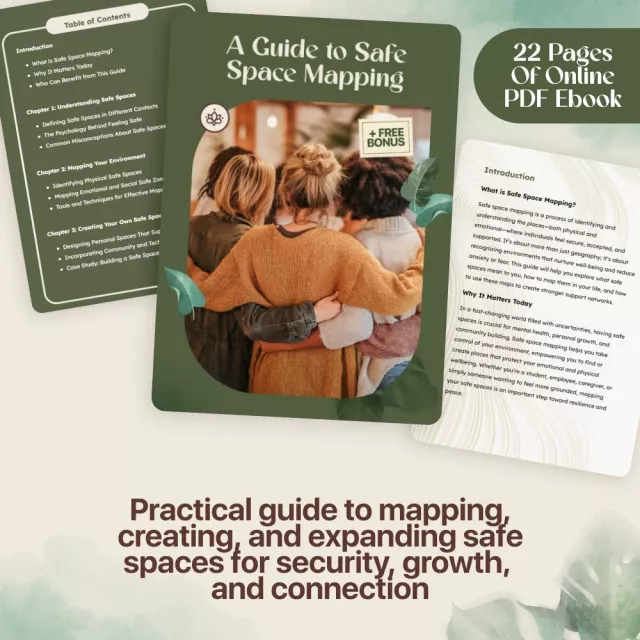
If you want a ready-made structure to fill in, the A Guide to Safe Space Mapping | Digital Ebook on Understanding, Creating & Using Safe Spaces can help turn these categories into a repeatable plan you can revisit as life changes.
Identify a low-traffic spot and pair it with a brief regulation routine that doesn’t draw attention: refill water, take a stair lap, do a 30-second grounding scan, or step outside for air. Keeping your phone at a set distance can also reduce impulsive scrolling during stress; an Adjustable Tabletop Phone Stand for Livestreaming & Vlogging can help create that “hands-off” buffer when you’re trying to stay regulated.
Build a small kit that fits in a bag or pocket: earplugs, mints, sunglasses, lotion, a fidget, and a notes-app checklist for your recovery steps. Sensory design matters—tiny adjustments to sound, light, scent, temperature, and visual clutter often create big safety gains. If scent is grounding for you, a simple decision guide like Your Everyday Scent Made Simple – Daily Perfume Checklist can help you choose a consistent “safe” option that doesn’t overwhelm.
For broader education on stress and trauma-informed approaches, these resources are helpful: American Psychological Association (APA) – Stress resources and SAMHSA – Trauma-Informed Care.
General mental health information is also available from the World Health Organization (WHO) – Mental health.
Safe space mapping is a practical method for identifying and organizing the places, people, routines, and boundaries that help you feel safe and regulated. It often uses tiers (quick, medium, extended) so you can choose support that matches the moment and is repeatable in everyday life.
They reduce sensory and social load while increasing predictability, which supports nervous system regulation. Examples include stepping into a quiet zone, doing a brief grounding practice, or contacting a trusted person; these supports can complement (not replace) professional care when needed.
Create strong boundaries with privacy settings, moderation, and mute/block tools, then limit notifications and schedule specific check-in windows. Keep a simple aftercare routine ready—if content becomes triggering, switch to an offline regulation step before you decide whether to re-engage.





Leave a comment