
Retirement planning is shifting from static assumptions to living, data-aware plans. Artificial intelligence can help organize goals, stress-test scenarios, and highlight trade-offs—so decisions about saving, investing, taxes, and withdrawals stay aligned as life changes. Used responsibly, AI can reduce planning friction and help you ask better questions, faster. The goal isn’t to “hand off” your future to a model—it’s to build a clearer roadmap and keep it updated as your income, family needs, markets, and health costs evolve.
Traditional retirement plans often revolve around a single forecast: a target dollar amount and a presumed rate of return. AI-assisted planning pushes you toward a more resilient approach.
A helpful way to use AI is to treat it like a planning co-pilot: you provide the intent and constraints; it helps you explore the consequences. Here’s a workflow that stays grounded and repeatable.
Start with outcomes, not accounts: a retirement age range, desired monthly spending, and non-negotiables like housing, healthcare, and debt payoff. If travel or family support is a priority, define a rough annual budget for it.
List what you have and what you expect: 401(k), IRA, taxable accounts, pension estimates, Social Security estimates, cash reserves, and insurance. When estimating Social Security, rely on official resources and your statement assumptions (see Social Security Administration — Retirement Benefits).
Constraints make projections more realistic. Decide what portfolio drop you could tolerate without panicking, your minimum cash buffer, and the maximum ongoing contribution you can sustain even during busy or uncertain years.
Compare a baseline against “pessimistic” and “optimistic” paths. Add specific stress tests: early retirement, higher inflation, contribution pauses, and an unexpected medical expense. The purpose is not to predict the future—it’s to identify the weak points in your plan.
Use scenario results to pick concrete moves: increase savings, adjust retirement date, modify spending, or realign your investment mix. Small changes—made early—often have outsized impact.
Plan for light quarterly check-ins and an annual deep review. Update assumptions, confirm beneficiaries, and rebalance when appropriate. This rhythm is where AI shines: quick refreshes that keep the plan “alive.”
For retirement account rules and IRA-related guidance, verify details using a primary source like IRS — Retirement Plans FAQs.
For a consumer-focused overview of retirement planning fundamentals, consult FINRA — Basics of Retirement Planning.
| Approach | Best for | Strengths | Watch-outs |
|---|---|---|---|
| AI budgeting + cash-flow categorization | Improving savings rate and consistency | Finds spending leaks; supports automation and targets | May misclassify transactions; requires occasional cleanup |
| Scenario modeling (Monte Carlo-style projections) | Testing retirement age and spending levels | Shows probability ranges; highlights sequence-of-returns risk | Outputs depend heavily on assumptions; false precision risk |
| Tax-aware planning assistants | Roth conversions and withdrawal sequencing | Surfaces bracket thresholds and timing opportunities | Tax rules are nuanced; verify with current-year guidance |
| Advisor + AI-enabled planning | Complex situations and accountability | Blends tools with fiduciary judgment and personalized advice | Costs vary; confirm scope, fees, and incentives |
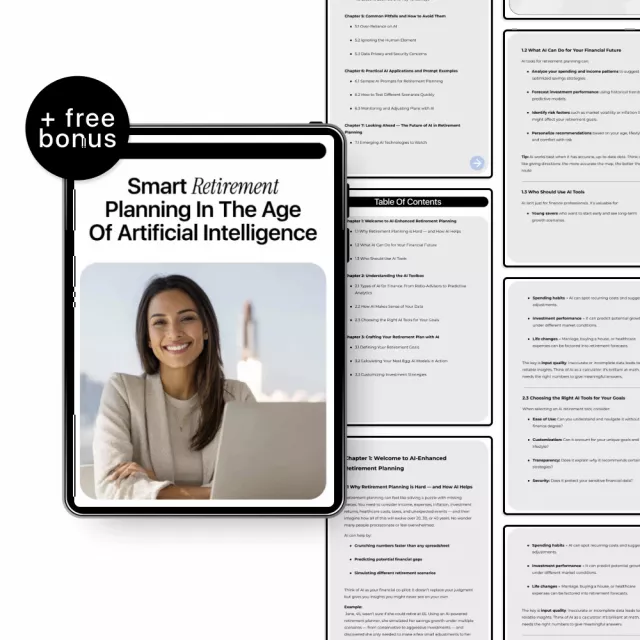
AI can generate ideas, but a plan becomes actionable when it’s organized into decisions, checkpoints, and next steps. If a structured framework would help, consider the Smart Retirement Planning in the Age of Artificial Intelligence eBook, which is designed to connect scenario outputs to practical choices across savings, risk management, taxes, withdrawals, and ongoing maintenance.
For a smoother planning routine—especially if you do virtual check-ins with a spouse or a financial professional—an ergonomic setup can reduce friction. An Adjustable Tabletop Phone Stand for Livestreaming & Vlogging can be a simple upgrade for hands-free calls while you review statements, projections, and action lists.
AI can organize inputs, generate checklists, and run scenarios, but it can’t guarantee assumptions are correct or account for every tax and legal nuance. For complex situations or high-stakes decisions, verify outputs and consider professional review.
Avoid sharing Social Security numbers, login credentials, full account numbers, or unredacted statements. Use totals or ranges when possible, and confirm the platform’s data retention and privacy policies before entering sensitive details.
Quarterly light reviews plus an annual deep review work well for most people. Update immediately after major life changes such as a job change, health event, move, marriage/divorce, or a significant market shock.






Leave a comment